The Silent Crisis: Why the World is Running on Empty
- Oct 18, 2025
- 7 min read
Updated: Oct 24, 2025
Imagine a world where half the population struggles to find water for a month every year. That's not a dystopian future—it's the world we live in today. The global water crisis is one of the most urgent and complex threats we face, marked not just by simple scarcity but by water stress and widespread pollution. This is a full report on the severity of the situation, from today to the alarming projections of 2050.
The Crisis Today: Numbers That Shock
The problem isn't just about 'not enough' water; it's also about "dirty water" and unequal access. While the Earth is covered in water, only about 0.5% is usable, available freshwater, and we are dangerously over-extending that supply.
Statistic | The Reality of the Crisis Today |
Water Stress Exposure | Approximately 4 billion people (half the world's population) live under highly water-stressed conditions for at least one month a year. |
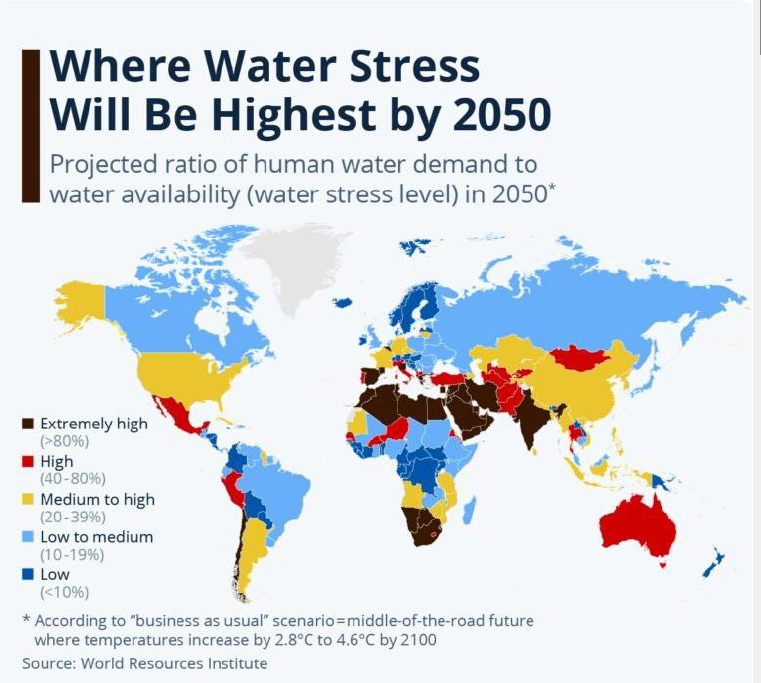
Extreme Water Stress | 25 countries (housing one-quarter of the global population) face extremely high water stress annually, regularly using up over 80% of their available water supply. |
Lack of Safe Drinking Water | Over 2 billion people worldwide still lack access to safely managed drinking water. |
Sanitation Crisis | 3.5 billion people lack safely managed sanitation services. |
The Human Cost (Health) | Over 1,000 children under 5 die every day from diseases related to a lack of clean water, sanitation, and hygiene (WASH) |
The Burden on Women | Women and girls spend an estimated 250 million hours every day collecting water, often walking an average of 6 kilometers (3.7 miles) daily. |
Water Quality | More than 80% of the world's wastewater flows back into the environment without being treated, making pollution a massive threat to the usable supply. |
The Engines of Scarcity: How Did We Get Here?
The water crisis is a complex mix of environmental factors and human activity, categorized into two main types of scarcity:
Physical Water Scarcity: When natural water resources are simply not enough to meet all demands, including the water needed for ecosystems. This is common in dry, arid regions but is also occurring where resources are over-committed.
Economic Water Scarcity: When a country or region has enough water but lacks the infrastructure or financial means to pipe, treat, and deliver it in an accessible, safe manner. This is the most common form of scarcity in much of Sub-Saharan Africa [2.5].
The Main Drivers of the Crisis:
Climate Change: Rising global temperatures disrupt the entire water cycle, leading to more extreme weather. This results in more frequent and severe droughts in some regions and floods in others, making water supplies less predictable.
Over-Consumption by Agriculture: Agriculture is the biggest culprit, accounting for about 70% of global freshwater withdrawals. Inefficient irrigation, like flood systems, wastes an estimated 60% of that water, rapidly draining rivers and underground aquifers faster than they can refill.
Pollution and Wastewater: Contamination from industrial waste, agricultural runoff (pesticides, fertilizers), and untreated human wastewater reduces the amount of safe water available. Over 80% of wastewater globally is released untreated, poisoning water sources.
Population Growth and Poor Management: As the global population grows, so does the demand for water for domestic and industrial use. Old, leaky infrastructure can lose up to 30% of treated water before it reaches consumers, turning potential abundance into scarcity through poor management.
The Road to 2050: A Critical Projection
If we continue with a "business as usual" approach, the situation is projected to become dire, leading to economic instability and intensified conflict:
More People in Extreme Stress: By 2050, up to 60% of the world's population could be exposed to water stress for at least one month of the year.
Exploding Demand: Global water demand is projected to increase by 20% to 25% by 2050.
Regional Catastrophes: In the Middle East and North Africa, projections show that 100% of the population will live with extremely high water stress by 2050. Countries like India, Iran, and those on the Arabian Peninsula are expected to be among the most severely affected.
Economic Fallout: The value of global GDP exposed to high water stress is projected to rise from $15 trillion in 2010 to a staggering $70 trillion (31% of global GDP) by 2050.
This future of increasing scarcity, coupled with climate change, will fuel political instability and conflict, with water becoming a contested resource between countries, industries, and communities.
The Path Forward: Hope Through Action
The good news is that cost-effective solutions exist, but they require a massive shift in how we value and manage water.
Sector | Key Solutions to the Water Crisis |
Agriculture | Transform irrigation by switching from wasteful flood methods to efficient techniques like drip irrigation. Grow water-wise crops suitable for the local climate. |
Technology | Invest in new supplies via desalination (making it more energy-efficient, perhaps solar-powered) and wastewater recycling and reclamation for non-potable uses. |
Infrastructure | Repair and upgrade old distribution systems to stop leakage and waste. Implement better rainwater harvesting and floodwater catchment systems. |
Policy & Governance | Implement sustainable water management policies and appropriate water pricing to incentivize conservation. Foster global cooperation on transboundary water resources. |
Conservation | Protect and restore natural ecosystems like wetlands and forests, which are vital for filtering, storing, and releasing clean water naturally. |
The crisis is immense, but the resources and ingenuity to solve it are within reach. It is up to governments, corporations, and every single individual to make the conservation and security of our most vital resource—water—the single most urgent priority.
1. Aqua Credits (AQC)
Aqua Credit is a blockchain-based water credit marketplace that monetizes the value of clean water generation and savings, creating economic incentives to invest in sustainable water management.
Feature | Description | |
ACT Token | 1 AquaCredit token (AQC) represents 1/m3 of verified clean water (supplied or saved elsewhere). | |
Verification | The system uses an IoT device called the AquaCredit Box. This device is installed on water projects (like recycling plants, rainwater systems, or Atmospheric Water Generation (AWG) technology) to automatically verify the water volumes generated or saved using sensors. | |
Function | It operates similarly to the CO2 carbon credit market. Companies can : • Offset Usage: Purchase AquaCredits to compensate for their water usage and improve their "water neutrality" profile for ESG reporting. • Generate Revenue: Issue their own AquaCredits by completing water projects, allowing them to turn water savings or new production into a new source of revenue. |
Contribution to World Water Problems
Aqua Credits tackles the global water crisis by introducing a market mechanism to water management, driving investment and rational use:
Financial Incentive: It creates an economic incentive to invest in water efficiency, water reuse, and climate adaptation projects by providing an income stream (via token sales) to project developers.
Climate Adaptation: It supports climate adaptation efforts by making technologies like rainwater collection and storage economically attractive. The resulting credits monetize the value of storing water for dry periods, helping to mitigate drought risk.
Green Financing Channel: It acts as a link between investors/green financing (like the $\mathbf{\text{€}20}$ billion the EU aims to free up for water restoration) and specific water projects, ensuring money flows efficiently to where water is actually created or saved.
ESG Compliance: It provides verified, real-time data on water savings that companies can use to comply with strict reporting requirements like the EU's Corporate Sustainability Reporting Directive (CSRD) and improve their ESG rating.
2. SWS HydroFusion Technology
SWS HydroFusion is an integrated, self-sustaining system for combined crop production and potable water generation.
Component | Function |
Agrivoltaic Solar Canopy | Solar panels are installed above crops to generate clean, off-grid electricity for the system, while also providing partial shade to reduce crop heat stress and water evaporation. |
Atmospheric Water Condensation (AWG) | The system pulls moisture from the ambient air to produce water, which can function even in arid conditions. The capacity is up to 50,000 liters daily per container. |
Integrated Water Purification | The generated water is purified via a Reverse Osmosis (RO) plant contained within the unit, ensuring high-quality potable water. |
Reconfigurable Management | The system can produce clean drinking water and irrigation water simultaneously or on demand. A multi-purpose tank manages the water for remineralization (for drinking) or precise fertilizer dosing (fertigation) for crops. |
Design | The entire system is modular, self-sustaining, and housed in a transportable ISO container for rapid setup and deployment in off-grid locations. |
Contribution to World Water Problems
HydroFusion addresses the critical Water-Energy-Food Nexus Challenge by integrating all three components into one solution:
Off-Grid Water and Food Security: It is designed for off-grid deployment in target markets like remote communities, drought-prone agricultural regions, and disaster relief zones. Operating independently of external power and water sources, it provides access to clean water and food in vulnerable areas.
Mitigating Water Scarcity in Agriculture: The agrivoltaic synergy maximizes land and water efficiency. The combination of AWG water production and solar-shade reduction of crop stress can lead to a 30-50% reduction in water stress for fields and 10-25% higher crop yields in pilot projects.
Integrating with Aqua Credit Tokens (ACT): The two systems can be used together. A pilot project in Southern Europe, specifically on wine and citrus farms, is investigating the integration of AWG units (like those in HydroFusion) where AquaCredits are used as a financial incentive to document water neutrality and make the water generation economically viable. The water generated by HydroFusion can be measured by the AquaCredit Box, tokenized, and sold on the marketplace, creating an additional revenue stream to finance the water generation and food production.
Environmental and Social Impact: It aligns with multiple UN Sustainable Development Goals (SDGs), including Clean Water and Sanitation (SDG 6) and Zero Hunger (SDG 2).

Comments